
El Dado carries layered meaning rooted in language, symbolism, and cultural expression. The phrase comes from Spanish, where “dado” translates to “dice.” In everyday use, it connects with chance, probability, and decisions shaped by uncertainty. Over time, the term has expanded beyond its literal sense and entered idiomatic speech, artistic expression, and even philosophical discussions about fate and randomness.
Literal Meaning of El Dado
At its most direct level, El Dado refers to a single die the small cube marked with numbers from one to six. This object has existed for thousands of years and appears across civilizations as a tool for games and decision-making.
Dice have always symbolized:
- Chance and unpredictability
- Risk-taking behavior
- Fairness and randomness
- Decision-making under uncertainty
The Spanish phrase keeps this original meaning intact while also adapting to different contexts.
Linguistic Roots and Etymology
The word dado comes from the Latin term “datum,” meaning “something given.” This origin adds depth to its meaning. Rather than random chance alone, it suggests something assigned or handed down.
In Spanish grammar:
- El = masculine definite article (“the”)
- Dado = die or cube used in games
Together, El Dado translates directly to “the die.”
Symbolism of El Dado
El Dado goes beyond a gaming object. It acts as a symbolic representation in various contexts:
1. Fate and Destiny
Rolling a die mirrors life’s unpredictability. People use the phrase to describe moments where outcomes feel out of their control.
2. Risk and Decision
In conversations, “tirar el dado” (to roll the dice) suggests taking a risk without certainty.
3. Equality and Fair Play
A die treats all outcomes equally. This creates an association with fairness and impartial decisions.
Cultural Presence of El Dado
El Dado appears in many areas of daily life and creative expression.
Gaming Culture
Dice games remain popular worldwide. From traditional board games to gambling environments, El Dado stays central to gameplay mechanics.
Common examples:
- Board games like Ludo and Monopoly
- Casino games such as craps
- Informal street games
Literature and Art
Writers and artists use El Dado as a metaphor for unpredictability. It appears in poetry, novels, and visual art to express uncertainty and life choices.
Everyday Language
In Spanish-speaking regions, phrases connected to El Dado appear in casual speech:
- “El dado está echado” (The die is cast)
- “Jugar con el dado” (To take a chance)
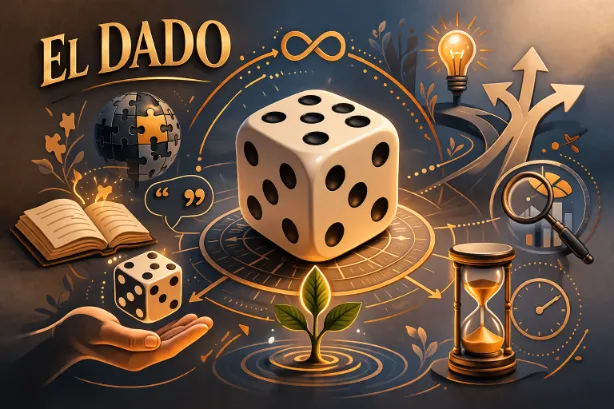
El Dado in Philosophy and Thought
Philosophers and thinkers have long connected dice with deeper questions about life.
Determinism vs Randomness
El Dado represents randomness, challenging the idea that everything follows a fixed path.
Free Will
Using a die to make decisions raises questions about control and human choice.
Probability Theory
Mathematicians study dice to understand probability, forming the foundation of statistics and risk analysis.
Practical Uses of El Dado
Beyond symbolism, El Dado serves real purposes in various fields:
Decision-Making Tool
People sometimes use dice to break indecision. Assigning options to numbers creates a simple decision method.
Education
Teachers use dice in classrooms to teach:
- Probability
- Arithmetic
- Strategic thinking
Game Design
Modern video and board games still rely on dice mechanics to introduce unpredictability.
Key Characteristics of El Dado
| Feature | Description |
|---|---|
| Shape | Cube with six faces |
| Numbers | 1 to 6 |
| Purpose | Random outcome generation |
| Material | Plastic, wood, metal, or bone |
| Use Cases | Games, probability study, decision-making |
Types of Dice Related to El Dado
While El Dado refers to the standard six-sided die, many variations exist:
- Four-sided (D4) – Pyramid shape
- Eight-sided (D8) – Used in role-playing games
- Ten-sided (D10) – Often seen in advanced gaming
- Twenty-sided (D20) – Popular in tabletop RPGs
These variations expand the concept of randomness while maintaining the same core idea.
In Modern Digital Culture
Technology has transformed how people interact with El Dado.
Digital Dice
Online platforms and mobile apps simulate dice rolls. These tools serve gamers and educators alike.
Video Games
Game developers use virtual dice systems to control outcomes, rewards, and player progression.
Random Generators
The concept of El Dado has evolved into broader randomization tools used in:
- Software development
- Data science
- Artificial intelligence
Idiomatic Expressions Using El Dado
Spanish language uses El Dado in expressions that carry deeper meaning:
- “El dado está echado”
Suggests a decision has already been made and cannot change - “Jugarse todo a un dado”
Means risking everything on one chance - “Tirar los dados”
Refers to making a decision based on luck
These phrases show how language adapts simple objects into powerful expressions.
Psychological Meaning Behind El Dado
Human behavior connects strongly with randomness. El Dado helps explain:
Risk Behavior
People take more risks when outcomes seem uncertain but exciting.
Decision Anxiety
Using randomness can reduce pressure in tough choices.
Illusion of Control
Some believe they can influence random outcomes, even when logic says otherwise.
Why El Dado Remains Relevant
Despite technological progress, El Dado maintains relevance due to its simplicity and universal meaning.
Reasons for its lasting presence:
- Easy to understand
- Symbolic depth
- Practical use in games and learning
- Cultural integration across societies
Interesting Facts About El Dado
- Ancient dice date back over 5,000 years
- Early dice came from animal bones
- The opposite sides of a standard die always add up to 7
- Dice appear in many ancient civilizations, including Egyptian and Roman cultures
El Dado in Education and Learning
Teachers use El Dado to make lessons interactive and engaging.
Learning Benefits:
- Improves probability skills
- Encourages critical thinking
- Makes math enjoyable
- Develops strategic planning
In Everyday Life
El Dado quietly appears in many daily situations:
- Choosing between options
- Settling friendly disputes
- Adding fun to social gatherings
Its simplicity makes it accessible to all age groups.
What does El Dado mean in English?
El Dado translates to “the die,” referring to a single cube used in games.
Why does El Dado symbolize chance?
A die produces random outcomes, making it a natural symbol of unpredictability.
How does El Dado relate to probability?
Each face of the die represents an equal chance, forming the basis of probability theory.
Can El Dado be used for decision-making?
Yes, people assign choices to numbers and roll the die to decide.
Why do opposite sides of a die add up to 7?
This design ensures balance and fairness in standard dice.