
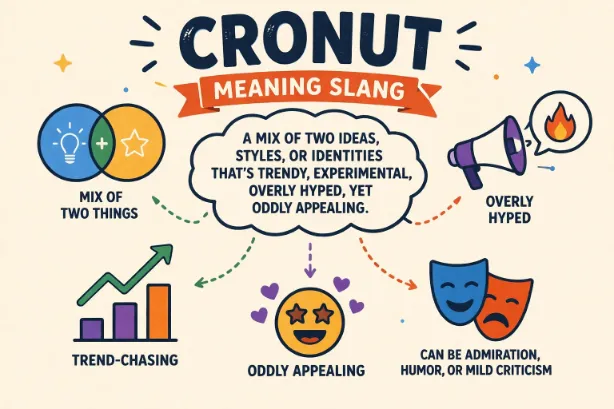
“Cronut” in slang circles goes far beyond a pastry reference. While the original term points to a hybrid of a croissant and a donut, slang usage transforms it into a playful, sometimes sarcastic expression that signals excess, trend-chasing, or something overly hyped yet oddly appealing. In modern conversations, especially online, “cronut” works as a metaphor rather than food.
At its core, slang “cronut” describes something that mixes two ideas, styles, or identities in a way that feels trendy or experimental. It can carry admiration, humor, or mild criticism depending on context.
Origin of the Word “Cronut”
The word began as a food invention that quickly spread across social media and pop culture. Its uniqueness made it memorable, and soon the term escaped the bakery world.
People started applying “cronut” to:
- Fashion mashups
- Hybrid careers
- Social media personalities
- Creative projects
The transition from food to slang happened naturally because the original item already represented fusion and novelty.
Cronut Meaning in Slang Context
In slang, “cronut” describes something that:
- Combines two different things
- Feels trendy or overhyped
- Looks attractive but may lack depth
- Appeals strongly on social media
Interpretations
| Context | Meaning of “Cronut” |
|---|---|
| Social media | A trend people obsess over briefly |
| Personality | Someone mixing identities or styles |
| Fashion | A bold fusion outfit |
| Work/career | A hybrid role with unclear boundaries |
| Humor | Something unnecessarily complicated |
How People Use “Cronut” in Conversations
Slang evolves through casual use. “Cronut” appears in jokes, captions, and commentary where exaggeration or creativity fits.
Examples
- “That influencer’s content is such a cronut—half fitness, half drama.”
- “This movie feels like a cronut of five different genres.”
- “Your outfit is giving cronut vibes, but it works.”
The tone shifts based on delivery. It can sound playful or slightly critical.
Positive vs Negative Usage
The slang meaning doesn’t stay fixed. It swings between praise and critique.
Positive Tone
- Creative mix of ideas
- Fresh, innovative concept
- Unique personal style
Negative Tone
- Overhyped trend
- Confusing mix of elements
- Trying too hard to stand out
Quick Comparison
| Tone | Meaning |
|---|---|
| Positive | Stylish fusion, originality |
| Neutral | Mixed concept |
| Negative | Overcomplicated or gimmicky |
Why “Cronut” Became Slang
Several reasons pushed the word into slang territory:
- Memorable name – catchy and easy to reuse
- Symbol of fusion – already represented mixing
- Viral exposure – widely shared online
- Cultural shift – people enjoy hybrid concepts
Language adapts quickly, especially with social media. Words that represent ideas visually or emotionally tend to shift faster into slang.
Cronut in Internet Culture
Online spaces gave “cronut” a second life. It appears in memes, captions, and commentary where exaggeration adds humor.
Where It Shows Up
- Instagram captions
- TikTok comments
- Twitter jokes
- YouTube discussions
Common Themes
- Trend obsession
- Aesthetic overload
- Mixed identities
- Creative chaos
People use “cronut” to label something that looks appealing but feels slightly excessive.
Cronut as a Metaphor for Modern Trends
Modern culture thrives on combinations:
- Work + lifestyle branding
- Fitness + entertainment
- Fashion + technology
“Cronut” captures this shift in one word. It points to how ideas merge in today’s fast-paced environment.
Examples in Real Life
- A job combining marketing and content creation
- A fitness influencer posting lifestyle drama
- A product merging multiple features
These situations mirror the essence of a “cronut”a mix that grabs attention.
Differences Between Literal and Slang Meaning
| Aspect | Literal Cronut | Slang Cronut |
|---|---|---|
| Nature | Food item | Expression |
| Purpose | Eating | Describing trends |
| Tone | Neutral | Playful or critical |
| Meaning | Pastry hybrid | Conceptual hybrid |
The shift shows how language evolves from physical objects to abstract ideas.
Cronut vs Other Slang Terms
Slang constantly introduces new expressions. “Cronut” shares space with words describing trends and hybrids but keeps a distinct flavor.
Similar Terms
- Mashup
- Hybrid
- Trendy mix
- Aesthetic overload
What Makes “Cronut” Different
- Carries humor
- Feels slightly exaggerated
- Implies hype or novelty
- Suggests visual appeal
Cultural Relevance Today
The slang still appears in niche conversations, especially among younger audiences and online communities. Its relevance ties to how people view trends.
Why It Still Works
- People enjoy creative combinations
- Social media rewards uniqueness
- Humor thrives on exaggeration
- Short, catchy words spread faster
Even as new slang emerges, “cronut” keeps its place due to its flexible meaning.
When to Use “Cronut” in Slang
Using slang effectively depends on context. “Cronut” works best in informal settings.
Suitable Situations
- Casual conversations
- Social media captions
- Friendly teasing
- Creative writing
Situations to Avoid
- Formal writing
- Academic work
- Professional communication
The tone remains relaxed and playful, making it ideal for expressive language.
Misinterpretations
Some people misunderstand the slang meaning due to its food origin.
Misconceptions
- It only refers to desserts
- It always has a positive tone
- It describes something high quality
Reality
- It acts as a metaphor
- Tone changes based on context
- It may carry subtle sarcasm
Clarity depends on how the word appears in a sentence.
What does “cronut” mean in slang?
It refers to something that mixes different ideas or styles, often with a trendy or exaggerated feel.
Is “cronut” slang positive or negative?
Both. It can praise creativity or gently mock something overhyped.
Where did the slang come from?
It evolved from the pastry name after gaining popularity online and in pop culture.
Can “cronut” describe a person?
Yes. It can describe someone combining multiple styles, roles, or identities.
Is the term still popular?
It appears less frequently than newer slang but remains recognizable, especially online.