
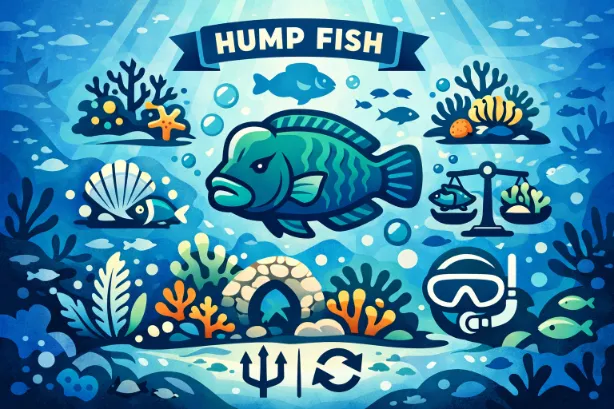
The hump fish, widely referred to as the Humphead Wrasse, ranks among the most striking reef species across tropical oceans. Its large forehead hump, thick lips, and vibrant blue-green body create a look that remains unforgettable. This species thrives in coral reef ecosystems and holds a powerful role in maintaining marine balance.
Physical Appearance and Unique Traits
The hump fish carries a strong, bulky body that can reach impressive sizes. Mature males develop a pronounced forehead hump, which becomes more visible with age.
Distinct features:
- Large, protruding forehead hump
- Thick, fleshy lips
- Bright coloration ranging from turquoise to deep green
- Intricate patterns across scales
- Powerful tail for steady movement
Males and females differ in appearance. Males grow larger and show stronger color contrasts, while females remain smaller and more subtle in tone.
Size and Lifespan
This species ranks among the largest reef fish in existence. Its size alone makes it easy to identify even from a distance.
| Attribute | Details |
|---|---|
| Average Length | 1–2 meters |
| Maximum Weight | Up to 180 kg |
| Lifespan | 30 years or more |
| Growth Pattern | Slow and gradual |
Such slow growth creates vulnerability to overfishing, which affects population recovery.
Habitat and Distribution
Hump fish live in warm tropical waters across the Indo-Pacific region. Coral reefs serve as their primary home, providing shelter and feeding grounds.
Common locations:
- Great Barrier Reef
- Coral reefs near Indonesia
- Coastal waters of the Philippines
- Red Sea reef systems
- Pacific islands such as Fiji and Palau
Juveniles prefer shallow lagoons and seagrass areas, while adults occupy deeper reef slopes.
Feeding Behavior
The hump fish acts as a predator within reef ecosystems. Its diet plays a role in controlling populations of certain marine creatures.
Diet consists of:
- Mollusks
- Crustaceans
- Sea urchins
- Starfish
- Small fish
One remarkable ability allows this species to crush hard shells using strong jaws. It even consumes toxic species like crown-of-thorns starfish, helping protect coral reefs from damage.
Behavior and Social Structure
Hump fish display calm and curious behavior. Divers frequently observe them approaching humans without fear.
Behavior traits:
- Slow, graceful movement
- Territorial habits
- Solitary or small group living
- High intelligence for a fish species
Many individuals recognize regular divers, creating rare interaction moments between humans and marine life.
Reproduction and Life Cycle
The reproductive pattern of hump fish follows a fascinating process. This species demonstrates protogynous hermaphroditism, meaning individuals begin life as females and later transition into males.
Reproductive facts:
- Spawning occurs in groups
- Seasonal breeding periods
- Eggs released into open water
- Larvae drift with ocean currents
Only a few females transform into dominant males, which manage breeding groups.
Ecological Role
Hump fish hold a strong position in coral reef ecosystems. Their feeding habits control species that could otherwise damage coral structures.
Ecosystem contributions:
- Regulate crown-of-thorns starfish populations
- Maintain coral health
- Balance reef biodiversity
- Support overall marine stability
Without such predators, reef ecosystems would face higher risk of degradation.
Threats and Conservation Status
Despite its strength and size, hump fish faces serious threats due to human activity. Overfishing remains the primary concern, especially in regions where this species holds high market value.
Major threats:
- Illegal fishing practices
- Live reef fish trade
- Habitat destruction
- Climate change affecting coral reefs
The species appears on conservation lists due to declining numbers. Protection measures exist in several regions, though enforcement varies.
Conservation Efforts
Various organizations and governments work to protect hump fish populations. Marine protected areas play a major role in preservation.
Protection strategies:
- Fishing restrictions
- Reef conservation programs
- Public awareness campaigns
- International trade regulations
Sustainable practices create hope for population recovery, though progress requires consistent global effort.
Cultural and Economic Value
In some regions, hump fish carries cultural importance and economic value. It appears in traditional practices and local fisheries.
Cultural aspects:
- Symbol of marine strength
- Featured in local folklore
- Considered a prized catch
However, demand in luxury seafood markets drives overexploitation, creating tension between economic gain and conservation.
| Category | Details |
|---|---|
| Scientific Name | Cheilinus undulatus |
| Common Name | Humphead Wrasse / Napoleon Fish |
| Habitat | Coral reefs |
| Diet | Carnivorous |
| Lifespan | 30+ years |
| Conservation Status | Endangered |
Interesting Facts
- The hump fish ranks among the few reef species that can eat toxic starfish.
- Its lips contain sensory abilities that help locate prey in crevices.
- Some individuals show friendly behavior toward divers.
- The forehead hump grows larger with age, especially in males.
- This species plays a protective role for coral ecosystems.
Human Interaction
Encounters between humans and hump fish remain memorable. Divers often describe close, peaceful interactions. The fish approaches slowly, showing curiosity rather than fear.
However, human activities also pose danger. Overfishing and reef destruction threaten its survival. Responsible tourism and sustainable fishing practices help reduce harm.
What does a hump fish eat?
It feeds on mollusks, crustaceans, and starfish. Strong jaws allow it to crush hard shells easily.
How big can a hump fish grow?
It can reach up to 2 meters in length and weigh around 180 kilograms.
Where can hump fish be found?
They live in tropical coral reefs across the Indo-Pacific region, including the Great Barrier Reef and Southeast Asia.
Why is the hump fish important for reefs?
It controls harmful species such as crown-of-thorns starfish, helping preserve coral health.
Is the hump fish endangered?
Yes, declining numbers have placed it under protection due to overfishing and habitat loss.