
Pars meaning has great depth across language, culture, and identity. The word appears in multiple contexts from historical roots tied to Persia to modern personal names and symbolic meanings. Each usage gives a slightly different sense, shaped by geography and tradition.
What Does “Pars” Mean?
At its root, Pars connects strongly to ancient Persia. The term refers to the original homeland of Persian civilization, historically called Parsa. Over time, this word shaped the modern name “Persia” and later “Iran.”
In a general sense, Pars conveys:
- Connection to Persian heritage
- Cultural identity tied to Iran
- Historical region linked to early empires
- Personal name with refined connotations
The meaning shifts slightly depending on usage, yet the connection to Persian origin remains consistent.
Historical Meaning of Pars
The historical side of Pars traces back thousands of years. The region of Parsa served as the heart of the Achaemenid Empire, one of the earliest large-scale empires in history.
Key historical points:
- Parsa existed in present-day southwestern Iran
- It served as the political center of early Persian rulers
- The name later evolved into “Persis” in Greek texts
- Eventually shaped the word “Persia”
This historical association gives Pars a strong sense of legacy and civilization.
Linguistic Meaning of Pars
From a linguistic angle, Pars relates closely to the Persian language itself.
- In Persian (Farsi), “Pars” connects to identity and nationality
- It can describe something related to Persian culture
- The word may also refer to linguistic purity or origin
The connection between Pars and Farsi reinforces its cultural depth.
Pars as a Personal Name
Pars appears as a given name in various regions, especially in Iran and surrounding areas. As a name, it carries meanings tied to dignity, heritage, and cultural pride.
Common interpretations of the name:
- Person connected to Persian roots
- Someone representing tradition and identity
- A name linked to nobility and history
Parents choose this name for its strong cultural tone and simplicity.
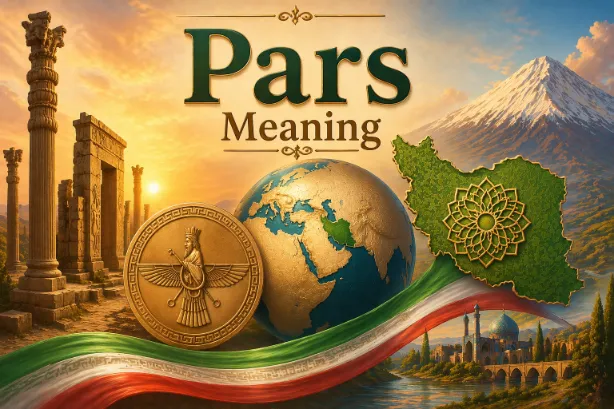
Cultural Meaning of Pars
Beyond history and language, Pars holds cultural weight. It symbolizes identity and continuity.
Cultural associations:
- Persian traditions and customs
- Classical literature and poetry
- Art, architecture, and heritage
- National pride in Iran
The word carries a sense of belonging for those connected to Persian culture.
Religious and Symbolic Meaning
In some contexts, Pars carries a symbolic or moral tone. It may represent purity or refinement depending on interpretation.
Symbolic meanings:
- Cleanliness or moral clarity
- Respect for heritage
- Simplicity with depth
These meanings are not universal but appear in certain interpretations and naming traditions.
Modern Usage of Pars
Today, Pars appears in multiple forms across daily life:
- As a first name
- In company names across Iran
- In cultural institutions
- In geographic references
Modern usage keeps the historical essence intact while adapting to contemporary settings.
Variations and Related Terms
Pars connects with several related words that share similar roots.
| Term | Meaning | Context |
|---|---|---|
| Parsa | Ancient name of Persia | Historical |
| Persian | People, culture, or language | Global usage |
| Farsi | Modern Persian language | Linguistic |
| Persis | Greek form of Pars | Classical texts |
Each variation adds another layer to the meaning of Pars.
Geographic Significance of Pars
Pars also relates to a specific region in Iran.
- Located in southern Iran
- Historical center of Persian empires
- Rich in archaeological sites
- Home to ancient cities like Persepolis
This geographic connection strengthens its identity as more than just a word.
Pars in Literature and Identity
Pars frequently appears in literature, especially Persian poetry and historical writing.
Writers have used the term to:
- Represent homeland
- Express cultural pride
- Connect with ancient roots
Its presence in literary works keeps the word alive across generations.
Why Pars Remains Relevant
Pars remains widely used due to its deep roots and adaptable meaning.
Reasons for continued use:
- Strong historical background
- Cultural identity connection
- Simple yet meaningful structure
- Versatile usage in names and places
It carries both tradition and modern relevance without losing its essence.
What is the exact meaning of Pars?
Pars refers to ancient Persia and carries connections to Iranian culture, heritage, and identity.
Is Pars a common name?
Yes, Pars appears as a personal name, especially in Iran and Persian-speaking communities.
Does Pars have a religious meaning?
In some contexts, it may represent purity or moral clarity, though this varies by interpretation.
Where is Pars located?
Pars refers to a historical region in southern Iran, central to early Persian empires.
Is Pars related to the Persian language?
Yes, it shares roots with the Persian language, also called Farsi.
What makes Pars unique?
Its combination of historical depth, cultural identity, and modern usage gives it lasting relevance.