
PRNDL refers to the sequence of letters displayed on automatic vehicle gear selectors. These letters P, R, N, D, and L represent different transmission modes that control how a car moves, stops, and responds to driver input. Each position connects directly to the transmission system and determines how power transfers from the engine to the wheels.
Drivers rely on PRNDL every time they start, move, or park a vehicle. This simple set of letters removes the need for manual gear shifting and allows smooth operation in daily driving situations. A clear grasp of PRNDL helps reduce mechanical strain and improves road safety.
What PRNDL Stands For
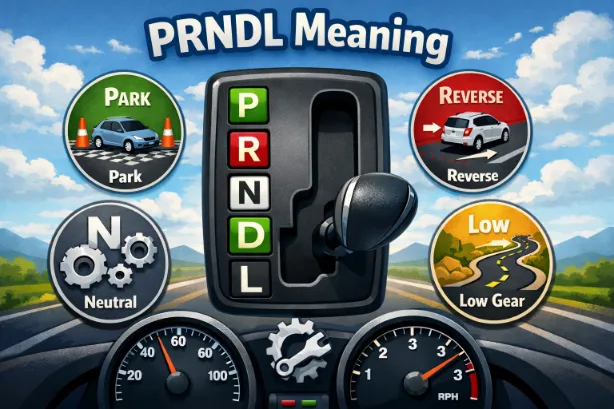
PRNDL forms an acronym based on five essential gear positions found in automatic cars. These positions remain standard across most vehicles, regardless of brand or design. Each letter represents a specific function that directly affects vehicle behavior.
- P – Park
- R – Reverse
- N – Neutral
- D – Drive
- L – Low Gear
Each position serves a distinct purpose, and drivers switch between them depending on movement, direction, or road conditions. This structure creates a predictable and user-friendly driving experience.
PRNDL Positions Explained
Park (P)
Park locks the transmission and prevents the wheels from rotating. Drivers use this mode after bringing the vehicle to a complete stop. It activates an internal locking mechanism that keeps the car stationary.
Using Park on slopes without engaging the handbrake may place stress on the transmission. For better safety, drivers should apply the parking brake along with selecting Park.
Reverse (R)
Reverse enables backward movement by changing the direction of the transmission output. Drivers use this mode for backing out of parking spots or repositioning the vehicle.
Switching into Reverse requires a full stop. Attempting to shift while the car still moves forward can damage the transmission and lead to costly repairs.
Neutral (N)
Neutral disconnects the engine from the wheels, allowing the engine to run without moving the vehicle. In this position, the car can roll freely.
This mode helps during towing or mechanical checks. Driving downhill in Neutral reduces control and removes engine braking, which increases risk.
Drive (D)
Drive activates forward motion and allows the transmission to change gears automatically. The system adjusts gear ratios based on speed and acceleration.
This position suits most driving situations, from city traffic to highway travel. It keeps the vehicle running smoothly without manual intervention.
Low Gear (L)
Low gear limits the transmission to lower gear ranges. This setting delivers more power and better control at lower speeds.
Drivers use Low gear on steep hills, rough terrain, or while carrying heavy loads. It also helps maintain control during downhill driving by reducing speed without heavy braking.
PRNDL Layout in Vehicles
PRNDL appears in different formats depending on vehicle design. Some cars display it on the gear lever, while others show it on the dashboard or steering column.
Modern vehicles may replace traditional levers with buttons or rotary knobs. Despite these changes, the PRNDL sequence remains consistent, making it easy for drivers to adapt across different cars.
How PRNDL Works in Automatic Transmission
Automatic transmissions rely on a combination of mechanical and electronic systems. PRNDL positions send commands that control how gears engage and how power flows.
The system uses transmission fluid, sensors, and control modules to adjust gear shifts automatically. This process removes the need for a clutch and manual gear changes, allowing a smoother driving experience.
Core Functions
- Sensors detect selected gear
- Hydraulic systems transfer power
- Control modules adjust gear ratios
These components work together to deliver seamless performance.
PRNDL vs Manual Transmission
PRNDL simplifies driving compared to manual systems. Automatic transmissions handle gear shifting, while manual vehicles require direct driver control.
| Feature | PRNDL (Automatic) | Manual Transmission |
|---|---|---|
| Gear Control | Automatic | Driver-controlled |
| Ease of Driving | High | Requires practice |
| Clutch Use | Not required | Required |
| Fuel Efficiency | Moderate to high | Often higher |
| Learning Curve | Easy | Steeper |
Drivers who prefer convenience choose automatic systems, while those seeking control lean toward manual vehicles.
Mistakes with PRNDL
Incorrect use of PRNDL may lead to transmission damage or safety issues. Many drivers develop habits that affect vehicle performance over time.
- Shifting into Park before stopping fully
- Switching to Reverse while moving forward
- Using Neutral while driving downhill
- Selecting Low gear on flat roads unnecessarily
Avoiding these mistakes helps maintain vehicle health and improves driving safety.
Modern Variations of PRNDL
Automotive technology has introduced extra driving modes alongside traditional PRNDL positions. These modes adjust vehicle performance based on driving needs.
Additional Modes
- S (Sport Mode) – Increases responsiveness and acceleration
- M (Manual Mode) – Allows driver-controlled gear selection
- E (Eco Mode) – Focuses on fuel efficiency
These features enhance flexibility while keeping the original PRNDL structure intact.
PRNDL in Electric Vehicles
Electric vehicles simplify transmission systems by removing multiple gears. Many still display PRNDL to maintain familiarity for drivers.
EVs deliver instant torque and rely on electronic controls rather than traditional gear mechanisms. Despite internal differences, the PRNDL layout helps drivers transition easily from fuel-based vehicles.
Why PRNDL Matters for Drivers
PRNDL directly affects how a vehicle behaves on the road. Each position influences movement, control, and safety.
Using the correct gear at the right time improves driving efficiency and reduces wear on mechanical parts. It also prevents accidents caused by incorrect gear selection.
Tips for Safe PRNDL Usage
Safe driving habits improve both performance and vehicle lifespan. Drivers should follow simple practices while using PRNDL.
- Stop completely before changing gears
- Use Low gear only in demanding conditions
- Avoid Neutral during motion
- Keep foot on brake while shifting
- Follow vehicle manufacturer instructions
These steps support smoother operation and better control.
Evolution of PRNDL System
Automatic transmission systems have developed over decades. Early vehicles required manual shifting, which demanded more effort and skill.
PRNDL introduced a simpler method for controlling gears. Over time, manufacturers improved the system with electronic controls and modern interfaces. Despite these changes, the original PRNDL sequence remains widely used.
What does PRNDL stand for in a car?
PRNDL represents Park, Reverse, Neutral, Drive, and Low gear, which control vehicle movement and direction.
Can I shift from Drive to Reverse directly?
No. A complete stop must occur before switching to Reverse to avoid damage.
Why does my car have extra letters beyond PRNDL?
Modern vehicles feature additional modes like Sport or Eco to adjust performance and efficiency.
Is Neutral safe while driving?
Neutral reduces control and removes engine braking. Drivers should keep the car in Drive during motion.
What happens in Park mode?
Park locks the transmission and prevents the wheels from moving.
Do electric cars use PRNDL?
Yes. Many electric vehicles use PRNDL for consistency, even though their internal systems differ.