
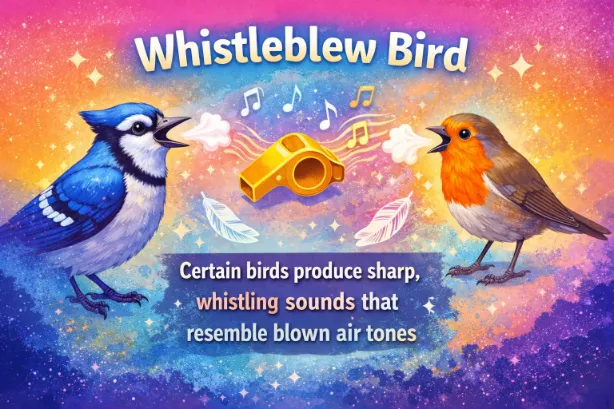
The term Whistleblew Bird points to a fascinating concept in avian behavior where certain birds produce sharp, whistling sounds that resemble blown air tones. These sounds carry across long distances and serve multiple purposes within natural habitats. From signaling territory to alerting others about threats, this behavior shapes communication patterns in bird populations.
Rather than referring to a single species, Whistleblew Bird works as a descriptive label for birds that rely on strong, whistle-based vocalizations. This category connects various species across regions, each adapting sound patterns to fit environmental needs.
What Defines a Whistleblew Bird
A Whistleblew Bird produces clear, high-pitched sounds created through controlled airflow in the syrinx (the vocal organ in birds). These whistles differ from chirps or songs due to their sharp tone and sustained frequency.
Main Characteristics
- High-frequency whistle tones
- Long-distance sound travel
- Repetitive or patterned calls
- Clear and piercing audio quality
- Strong territorial signaling
These traits allow such birds to communicate effectively across forests, wetlands, and open fields.
Natural Sound Mechanism
Birds generate whistles by pushing air through the syrinx while adjusting muscle tension. The result creates tones that vary in pitch and rhythm.
How the Process Works
| Step | Description |
|---|---|
| Airflow Control | Air passes through the syrinx |
| Muscle Adjustment | Muscles tighten or relax to change pitch |
| Resonance | Body structure amplifies sound |
| Projection | Sound travels across distance |
This process allows precise sound control, helping birds send specific signals.
Birds That Fit the Whistleblew Category
Several species display whistle-based communication. While each has unique calls, they share similar sound patterns.
Examples
- Blackbird – produces melodic whistles during dawn and dusk
- Whistling Duck – emits sharp, clear whistles while flying
- Golden Oriole – creates flute-like sounds with smooth tones
- Curlew – known for long, haunting whistles over wetlands
- Magpie Robin – uses varied whistle sequences in territorial calls
These birds adapt their whistles based on habitat and social structure.
Purpose of Whistle-Based Calls
Whistling plays a central role in survival and interaction. Each sound carries meaning depending on context.
Main Functions
- Territory Defense
Birds mark their area using repeated whistles to warn others. - Mate Attraction
Unique whistle patterns signal strength and health. - Alarm Signals
Sharp whistles alert nearby birds of predators. - Group Coordination
Flocks maintain connection through recognizable calls.
These functions shape daily bird behavior across ecosystems.
Habitat and Distribution
Whistleblew-type birds appear in diverse regions worldwide. Their presence depends on environmental conditions that support sound travel.
Preferred Habitats
- Dense forests with echo-friendly surroundings
- Open grasslands where sound travels freely
- Wetlands with minimal obstruction
- Coastal regions with wide acoustic range
Regional Spread
| Region | Bird Presence |
|---|---|
| Asia | High diversity in tropical zones |
| Europe | Seasonal whistle-based species |
| Africa | Strong vocal birds in savannas |
| Americas | Wide range across forests and plains |
Environmental factors influence how whistles evolve and spread.
Behavioral Patterns
Whistleblew birds follow structured communication routines. Their sound patterns shift depending on time of day and activity.
Daily Activity
- Early morning whistles establish territory
- Midday calls reduce as birds conserve energy
- Evening whistles increase for communication
- Nighttime sounds remain minimal for most species
Social Behavior
- Solitary birds use whistles for defense
- Flock birds use coordinated calls
- Males often produce stronger whistles during breeding periods
These patterns reveal organized communication systems.
Differences Between Whistles and Songs
Bird sounds fall into different categories. Whistles stand apart due to their structure and purpose.
| Feature | Whistle | Song |
|---|---|---|
| Tone | Sharp and clear | Melodic and complex |
| Duration | Short to medium | Longer sequences |
| Purpose | Signals and alerts | Courtship and expression |
| Complexity | Simple patterns | Multi-note variation |
This distinction helps identify Whistleblew Bird behavior in the field.
Adaptation and Evolution
Birds develop whistle sounds through gradual adaptation. Environmental pressure shapes tone, pitch, and repetition.
Factors Driving Change
- Predator presence
- Habitat density
- Climate conditions
- Competition for territory
Over time, birds refine their whistles to improve communication success.
Observation Tips
Identifying a Whistleblew Bird requires attention to sound rather than appearance alone.
Practical Tips
- Listen during early morning hours
- Focus on clear, sharp tones
- Notice repeated patterns
- Observe bird reactions to calls
- Use quiet surroundings for better detection
Field observation becomes easier with practice and patience.
Role in Ecosystems
Whistle-based communication contributes to ecological balance. These birds help maintain structure within their habitats.
Ecological Contributions
- Control insect populations
- Spread seeds through movement
- Maintain predator-prey awareness
- Support biodiversity through interaction
Their vocal signals influence behavior across multiple species.
Challenges and Threats
Environmental changes affect birds that rely on sound communication.
Major Threats
- Noise pollution disrupting signals
- Habitat destruction reducing range
- Climate shifts altering migration patterns
- Urban expansion limiting natural spaces
These factors interfere with communication efficiency.
Conservation Efforts
Protecting whistle-based bird species requires habitat preservation and noise control.
Key Actions
- Preserve natural habitats
- Reduce urban noise levels
- Support wildlife protection programs
- Promote awareness of bird communication
Conservation helps maintain balance in ecosystems where these birds live.
What does the term Whistleblew Bird mean?
It refers to birds that produce strong, whistle-like sounds for communication rather than pointing to one specific species.
Are whistle sounds natural or learned?
Both. Birds inherit the ability to whistle and refine patterns through listening to others.
Why are whistles so loud?
High-frequency tones travel farther and cut through environmental noise more effectively.
Can humans mimic these whistles?
Some whistles can be imitated, though exact replication remains difficult due to vocal differences.
Do all birds whistle?
No. Many birds chirp or sing instead, while only certain species rely heavily on whistle tones.
How can someone identify a Whistleblew Bird?
Focus on sharp, clear sounds that repeat in patterns and carry across distance.